
The Orion Constellation is one of the most noticeable and remarkable sights in the night sky, and it has fascinated stargazers for ages with its vast collection of deep sky objects. Sitting on the celestial equator, this stunning constellation is famous for its three bright stars that form the iconic belt, but it also boasts a wealth of nebulae, star clusters, and other celestial objects. Let’s take a look at some of Orion’s stars and deep sky objects, uncovering the secrets and marvels that make this constellation a real gem in the night sky.

Discover the Brilliant Stars of Orion
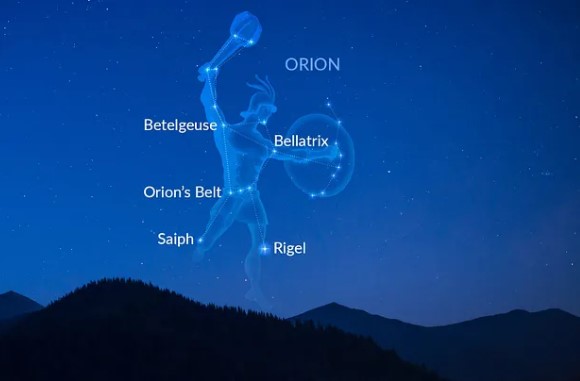
The constellation Orion is easily recognizable by its distinct shape, formed in part by four prominent stars: Rigel, Betelgeuse, Bellatrix, and Saiph. These stars outline Orion’s shoulders and feet, creating a roughly rectangular frame. Orion is home to two of the ten brightest stars in the night sky—Rigel and Betelgeuse.
Rigel, a brilliant blue giant, shines at a magnitude of 0.13. In contrast, Betelgeuse is a massive red giant with a magnitude of 0.50. It is an astonishing 700 times the size of our Sun—if placed in our solar system, it would extend beyond Jupiter’s orbit! As a red giant, Betelgeuse is nearing the final stages of its life, having exhausted the hydrogen in its core. Scientists predict it will go supernova in the relatively near future. The other two stars, Bellatrix and Saiph, are also blue giants, similar to Rigel.
Bellatrix may sound familiar to Harry Potter fans—J.K. Rowling incorporated many astronomical names into her books, including Sirius, Draco, Cygnus, Andromeda, and Luna.
One of Orion’s most recognizable features is Orion’s Belt, a striking row of three bright stars that have been vital for celestial navigation in the Northern Hemisphere since prehistoric times. These stars are:
- Alnitak – the easternmost star, whose Arabic name means “belt.”
- Alnilam – the central star, meaning “string of pearls.”
- Mintaka – the westernmost star, meaning “girdle.”
Together, these stars form one of the most iconic patterns in the night sky, guiding stargazers and navigators alike for thousands of years.
The Orion Nebula and The Running Man Nebula
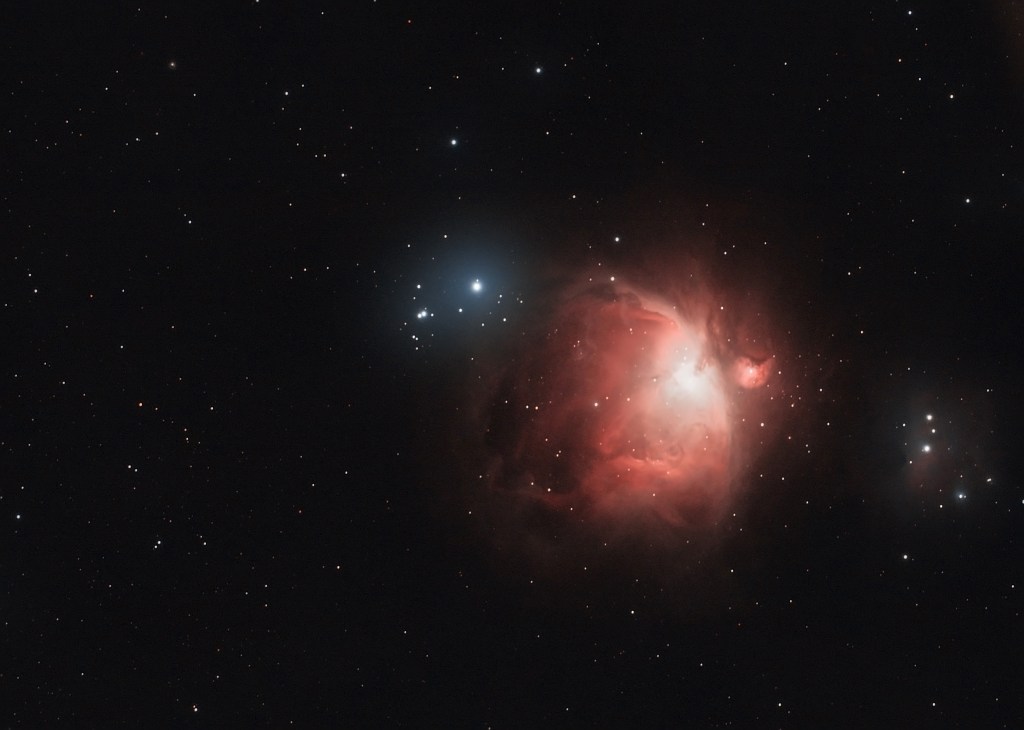
The Orion Nebula is one of the most iconic sights in the night sky. In fact, you can see it with the naked eye! To find it, locate the Orion constellation and look for Orion’s Belt—the three bright stars in a row. Just below the belt, you’ll notice a faint, fuzzy patch. That’s the Orion Nebula.
This stunning emission nebula shines at magnitude 4 and contains a bright core, where the tightly packed stars of the Trapezium Cluster reside. It’s a fantastic target for both visual observing and astrophotography, making it an ideal starting point for beginners.
The Running Man Nebula lies just beside the Orion Nebula and is a striking reflection nebula. It gets its name from its resemblance to the shape of—yes, you guessed it—a running man.
This nebula is part of the asterism known as Orion’s Sword, alongside its larger and brighter neighbor, the Orion Nebula (M42). While the Orion Nebula is visible to the naked eye, the distinctive outline of the Running Man is much more challenging to see through amateur telescopes. Instead, it is best captured through astrophotography.
My first astrophotography image was of the Orion Nebula—I simply held my phone up to the eyepiece of my Dobsonian telescope. From that moment, I was hooked!

The Horsehead Nebula
The Horsehead Nebula is a perennial favorite among stargazers. One of the most recognizable deep-sky objects, this dark nebula takes the shape of a horse’s head as a dense cloud of dust blocks the light from the bright star behind it. The striking red hue seen in photographs comes from hydrogen-alpha (Ha) gas illuminating the background. Located near Alnitak, the easternmost star of Orion’s Belt, the Horsehead Nebula lies approximately 1,500 light-years from Earth.
While a stunning target for astrophotography, the Horsehead Nebula is notoriously difficult to observe visually. To see it through a telescope, you’d need at least a 10-inch aperture and an H-beta filter to enhance its faint contrast against the surrounding glow.
Nearby, the Flame Nebula (NGC 2024) is a breathtaking emission nebula, home to a young open star cluster containing around 800 stars. Most of these stars are newly formed, with 86% still surrounded by circumstellar disks—potential birthplaces for future planets. The Flame Nebula lies between 1,300 and 1,600 light-years from Earth and is sometimes known by other names, including the Maple Leaf Nebula, the Burning Bush Nebula, and the Ghost of Alnitak. However, it is most commonly referred to as the Flame Nebula.

The Witch Head Nebula
The Witch Head Nebula is actually located in the constellation Eridanus, rather than Orion, though it lies close to Orion in the night sky. I’ve included it here due to its proximity. Its distinctive shape resembles a witch’s face, complete with a long nose and pointed chin.
The gas and dust of this nebula are lit by the star Rigel and it is believed that it is a supernova remnant. It is about 900 light years away from Earth and shines at a magnitude 13.
This nebula is actually quite large and can be difficult to fit the entire nebula in one image. You would need a focal length of 200-300mm in order to get it in a single frame. This is also a tough one to see visually but from a dark enough location, some people have said to have seen a faint glow with only binoculars!

NGC 2112 and Barnard’s Loop
Barnard’s Loop is a vast, glowing arc of hot gas within the Orion constellation. It is part of the Orion molecular cloud complex, which also includes the Orion Nebula and the Horsehead Nebula. Spanning more than 10 degrees across Orion, this massive nebula glows primarily in Hydrogen-alpha light, illuminated by ultraviolet radiation from young, hot stars. Although classified as an emission nebula, research suggests it likely formed from a supernova explosion between 2 and 4 million years ago.
A great way to observe this nebula is with large binoculars equipped with nebula filters. Its immense size makes it difficult to capture in a single telescope view. For astrophotography, the best approach is to take multiple long-exposure images using a modified DSLR camera mounted on a star tracker.
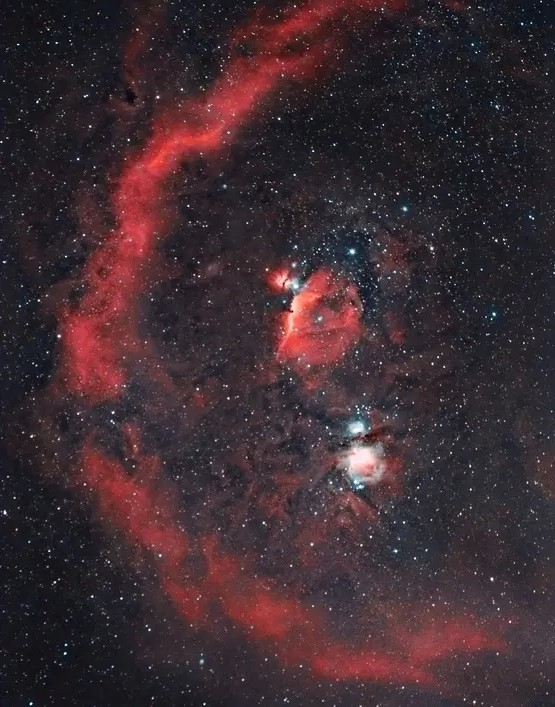
Orion is one of the most stunning and fascinating parts of the night sky. With its bright stars, iconic Belt, and incredible deep-sky objects, there’s always something to see. Whether you’re spotting the Orion Nebula with the naked eye, capturing the intricate details of the Horsehead Nebula, or tracing the massive arc of Barnard’s Loop, this constellation never disappoints.
For centuries, Orion has guided travelers, inspired legends, and fueled astronomical discoveries. And even today, every new observation or photo reveals something amazing. So next time you’re out under a clear night sky, take a moment to find Orion and explore the wonders it has to offer. Who knows what you might discover?
“Remember to look up at the stars and now down at your feet. Try to make sense of what you see and wonder about what makes the universe exist. Be curious. And however difficult life may seem, there is always something you can do and succeed at. It matters that you don’t just give up.”
– Professor Stephen Hawking
 Starry Skies